Improve · Longevity Coach article
Could Better Sleep Help Your Brain Age More Healthily?
Sleep isn't simply downtime. Research involving more than 27,000 UK adults found that poorer overall sleep was associated with brains that appeared older on MRI scans. So what can we learn from it — and what can we actually do?
By Longevity Coach Editorial Team ·
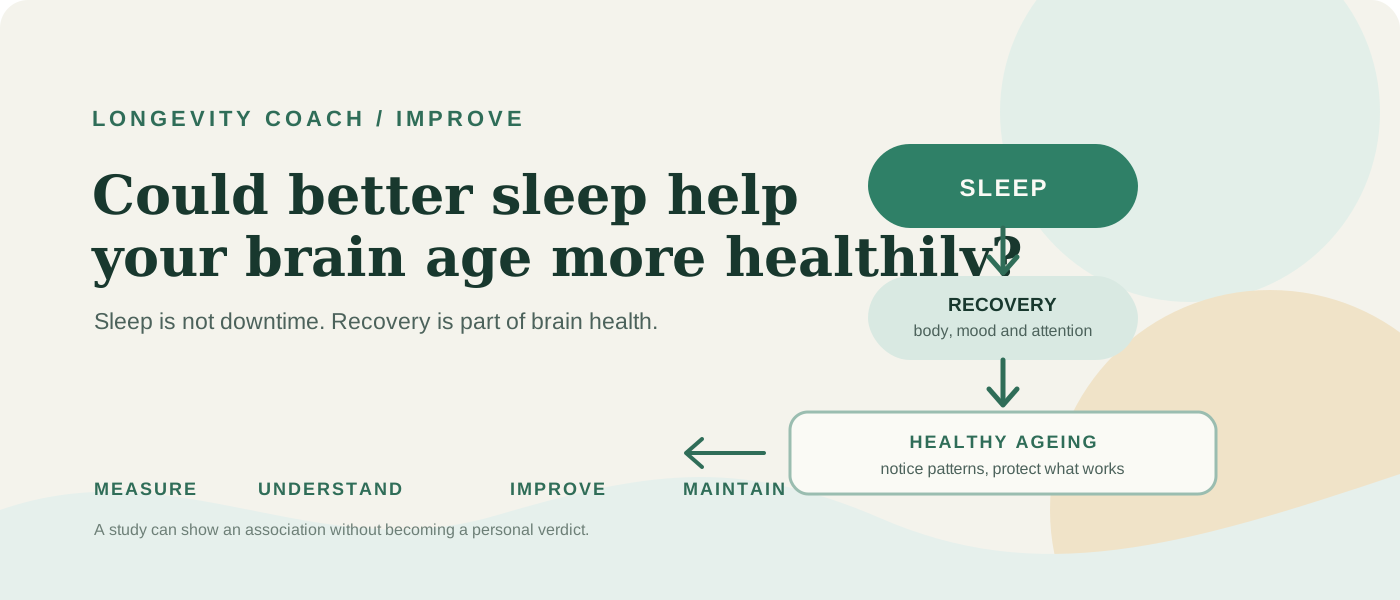
We spend roughly a third of our lives asleep.
It can therefore be tempting to regard sleep as eight hours when we are not achieving anything. Biologically, that is completely wrong.
Sleep supports physical recovery, cognition, metabolism and brain function. Now a large UK Biobank study has added another interesting piece to the puzzle. Researchers examined sleep information and detailed MRI brain scans from more than 27,000 adults. They found an association between poorer sleep health and brains that appeared older than expected for the participants' chronological ages.
That does not mean the researchers proved that a few bad nights make your brain older. This was an observational study. But it does give us another reason to take long-term sleep health seriously.
The short answer
Could better sleep help your brain age more healthily?
It may be part of the picture. People with poorer sleep profiles tended to have brains that appeared older according to an MRI-based research model. The study cannot prove that poor sleep caused the difference, or that improving sleep will make an individual brain younger. The practical lesson is to protect regular, restorative sleep without turning one difficult night into a diagnosis.
MEASURE. UNDERSTAND. IMPROVE. MAINTAIN.
What does an “older brain” actually mean?
Researchers can use MRI scans and machine-learning models to identify structural patterns associated with ageing. In this study, more than 1,000 MRI-derived brain characteristics were used to estimate a participant's apparent “brain age”. That estimate was then compared with their chronological age, producing a difference sometimes called the brain-age gap.
This is a research measurement. It is not the same thing as someone's biological age, and it is not a diagnosis. The estimate depends on the scan, the characteristics selected, the model and the comparison group. It is useful for studying patterns across many people; it is not a precise personal verdict.
Longevity Coach should not suggest that a questionnaire, smartwatch or ring can accurately determine your brain age. A device may provide useful trend information about sleep or activity, but it is not an MRI-derived research model and cannot diagnose brain health.
The study did not just count hours
One of the useful features of the research is that sleep health was treated as more than a single number. The researchers considered five self-reported characteristics:
Participants received a sleep-health score. Four or five healthy characteristics formed a healthy sleep profile; two or three formed an intermediate profile; and zero or one formed a poor sleep profile. The study treated seven to eight hours as the healthy sleep-duration characteristic.
That last point should not become an Longevity Coach rule that everybody needs precisely seven or eight hours. Individual sleep requirements vary. The bigger lesson is:
Eight hours in bed does not necessarily mean eight hours of good sleep.
What did the researchers find?
Across the study, poorer sleep scores were associated with an older estimated brain age. The brain-age gap increased by approximately half a year for each one-point decrease in the healthy sleep score. People classified as having poor sleep showed a greater brain-age gap than those with healthy sleep profiles. Later chronotype and abnormal sleep duration were among the individual characteristics showing notable associations.
How to read that result
People with poorer sleep profiles tended to have brains that appeared older according to the study's MRI-based model.
That is not the same as saying poor sleep ages your brain by a fixed number of years.
These are statistical associations across a large group of people. They do not tell us what happened first for any one person, and they cannot predict an individual's cognitive future. Sleep, health, circumstances and brain structure can influence one another in several directions.
Why might sleep and brain health be connected?
Inflammation
The researchers examined markers of systemic inflammation. Inflammation appeared to explain some — but only a minority — of the association between poorer sleep and older brain age. Their analysis estimated that approximately 10% of the association for the poorest sleep group could be statistically mediated by systemic inflammation.
That leaves most of the association unexplained. It is an important detail because it prevents a simple story in which sleep affects the brain through one measurable pathway.
Cardiovascular and metabolic health
Sleep can interact with factors affecting cardiovascular and metabolic health, which in turn matter to brain health. Blood pressure, glucose regulation, activity, weight, mood and medication can all sit in the same wider picture.
This is not a simple one-way chain. Poor sleep can be a consequence of health problems as well as a factor that makes them harder to manage. The responsible conclusion is that sleep deserves attention alongside the rest of the health picture.
Brain housekeeping
Research into the glymphatic system suggests that sleep is involved in the movement and clearance of metabolic waste from the brain. This is an active area of research, with important questions still open about how findings from laboratory and human studies fit together.
It is not established proof that improving one person's sleep will prevent dementia. It is better understood as one plausible reason that sleep and brain health may be connected, alongside many other biological, behavioural and social pathways.
What this study does not prove
- It does not prove poor sleep directly caused accelerated brain ageing.
- Much of the sleep information was self-reported.
- Brain age is an MRI-derived research estimate, not a diagnosis.
- Other health and lifestyle factors may influence both sleep and brain health.
- Poor sleep can sometimes be a consequence of health problems rather than their cause.
Interesting evidence should change the questions we ask — not make us pretend science has answered questions it has not.
So what can you actually do?
The study does not tell us that one perfect bedtime will change your brain age. It does support taking sleep health seriously as part of the Improve pillar. Conservative basics are still worthwhile:
- Keep your sleep schedule reasonably consistent. Aim for regular sleeping and waking times, including a routine that works at weekends.
- Give yourself enough opportunity to sleep. Do not routinely squeeze sleep to create more waking hours. Your own needs and circumstances matter.
- Watch caffeine later in the day. Caffeine can remain active for hours, and sensitivity varies. Notice whether later caffeine changes your sleep rather than relying on one universal cut-off time.
- Think about alcohol differently. Alcohol can make you feel sleepy while still disrupting sleep quality later in the night. This is a sleep effect, not a judgement.
- Create a sleep-friendly environment. A dark, quiet, comfortable room that is not excessively warm can make sleep easier.
- Move during the day. Regular physical activity can support sleep as well as wider health. Walking, gardening, cycling, swimming and strength work all count when they fit your capacity.
- Do not ignore persistent sleep problems. Ongoing insomnia, significant daytime sleepiness, loud snoring, witnessed breathing pauses or gasping deserve appropriate assessment. Sleep apnoea is one example of a condition worth identifying rather than treating poor sleep as a lifestyle failure.
These are conditions to make sleep more likely, not guarantees. A difficult night is not evidence that you have damaged your brain, and a good night is not proof that every health risk has disappeared.
Use the Longevity Coach framework without chasing a score
MEASURE.
Start noticing your approximate bedtime, wake time, estimated sleep duration, night waking, how rested you feel and daytime sleepiness.
UNDERSTAND.
Look for patterns rather than obsessing over individual nights. Ask whether sleep is being squeezed, bedtime is inconsistent or something regularly wakes you.
IMPROVE.
Choose one realistic intervention: a more consistent bedtime, earlier caffeine, less late alcohol, more daytime activity or a better bedroom environment.
MAINTAIN.
Keep what works and check whether it remains sustainable. Do not chase perfect sleep scores.
Longevity Coach members can review sleep patterns within their existing monthly check-ins. If you use the app, treat the information as context for reflection, not as a clinical measurement or a verdict on your brain.
Try this for seven days
Do not buy another gadget yet. For one week, simply record:
- when you went to bed;
- roughly when you fell asleep;
- when you woke;
- whether you woke during the night; and
- how rested you felt the following morning.
Then look for patterns. You cannot improve every night's sleep. You can improve the conditions you repeatedly give yourself for sleeping well.
Review your check-inDo not let your watch become the problem
Watches and rings can provide useful trend information, particularly around timing, consistency, movement and routine. But consumer devices estimate sleep and sleep stages. They do not measure them with the same methods used clinically, and they cannot diagnose insomnia, sleep apnoea or brain age.
Excessive concern about sleep-tracker scores can itself become counterproductive. Use measurements to understand yourself — not to give yourself another reason to worry. If a device reports a worrying pattern, consider the trend, your symptoms and an appropriate conversation with a healthcare professional.
Sleep is not disposable time
Sleep is one of the rare health behaviours where doing more is not necessarily the goal. The aim is appropriate, consistent and restorative sleep for your body and your life.
We cannot conclude from this study that improving sleep will make someone's brain younger. Combined with the wider evidence around sleep and health, it does provide another reason to stop treating sleep as disposable time.
Your brain does not switch off when you go to sleep.
In many ways, that is when some of its most important maintenance work begins.
Measure.
Understand.
Improve.
Maintain.
Frequently asked questions
Can poor sleep make your brain age faster?
The study found that poorer sleep profiles were associated with brains that appeared older according to an MRI-based model. It did not prove that poor sleep directly caused accelerated brain ageing or predict what will happen to any one person.
What is a brain-age gap?
A brain-age gap is the difference between an MRI-based estimated brain age and chronological age. It is a research measurement, not the same as biological age and not a diagnosis.
Does everybody need seven to eight hours of sleep?
The study treated seven to eight hours as its healthy sleep-duration characteristic, but individual sleep requirements vary. Sleep health is more than duration, so use the study as context rather than a universal prescription.
Can a smartwatch measure brain age or sleep accurately?
A smartwatch or ring can provide useful trend information about timing, movement and routine, but it estimates sleep and stages. It cannot measure MRI-derived brain age or diagnose a sleep disorder.
When should I ask for help with sleep?
Speak with your GP or another appropriate healthcare professional about persistent insomnia, significant daytime sleepiness, loud snoring, witnessed breathing pauses, gasping or other symptoms that affect your health and daily life. Sleep apnoea is one condition that may need assessment.
One useful healthspan insight each day.
Follow Longevity Coach for practical, evidence-informed ideas built around our approach: Measure. Understand. Improve. Maintain.
Follow Longevity Coach on WhatsAppSources / Further reading
- Miao Y et al.: Poor sleep health is associated with older brain age: the role of systemic inflammation, eBioMedicine (2025), 120:105941. DOI: 10.1016/j.ebiom.2025.105941.
- PubMed record for Miao et al. (2025).
- UK Biobank publication record for the study.
- NHS Every Mind Matters: Fall asleep faster and sleep better.
- NHS: Insomnia.
- NHS: Sleep apnoea.
- Liu et al.: The sleeping brain: harnessing the power of the glymphatic system through lifestyle choices, review of an active research area.
Medical disclaimer
This article provides general educational information and is not medical advice. A sleep tracker, questionnaire or Longevity Coach check-in cannot diagnose a sleep disorder or brain health condition. If sleep problems are persistent, severe or affecting your daily life, speak with your GP or another appropriate healthcare professional.